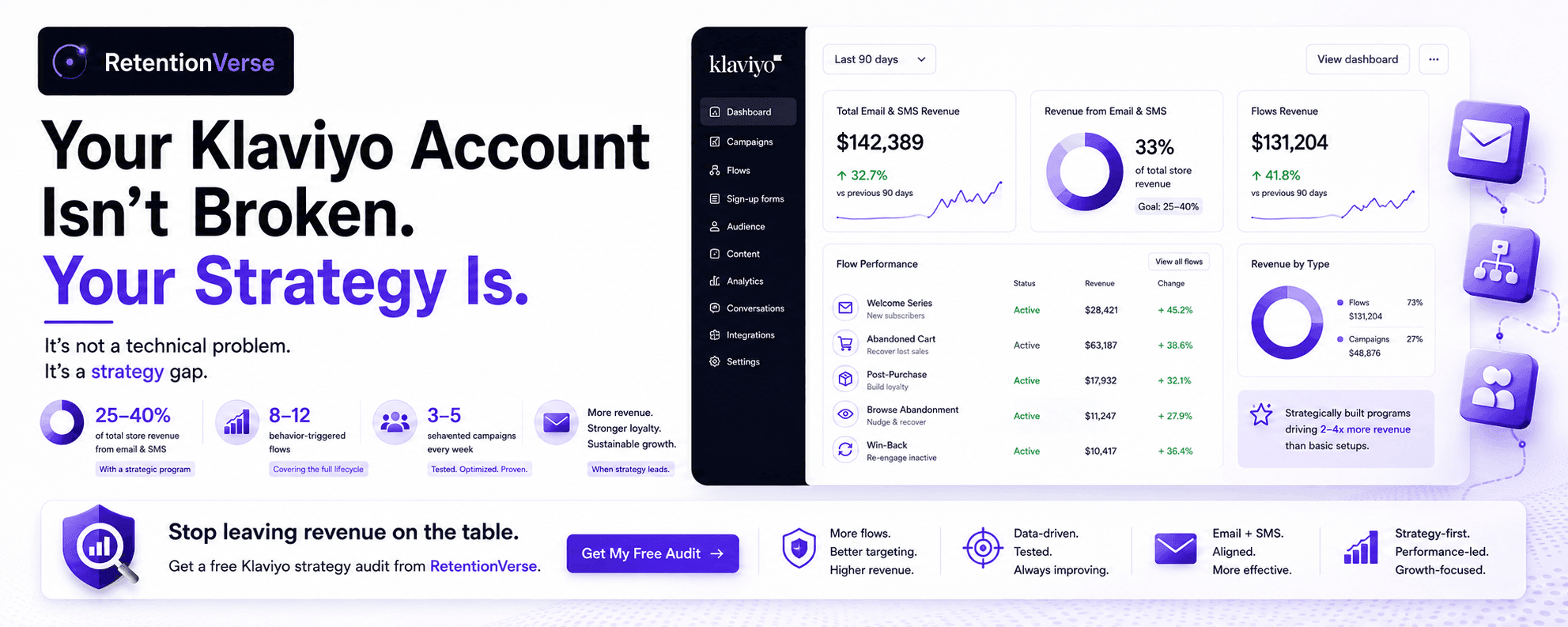
Your Klaviyo Account Isn't Broken. Your Strategy Is.
You've checked the integration. Shopify is synced. The flows show green checkmarks, no errors, no warnings. Every toggle that's supposed to be on is on. And revenue from email still sits well below where it should for a store your size.
At that point, most founders start looking for a bug that isn't there. The account isn't broken. It's functioning exactly as configured. The problem is what it was configured to do in the first place, and that's a strategy question, not a technical one.
"Working" and "Working Well" Are Two Different Things
Klaviyo will run a basic setup indefinitely without ever throwing an error. A welcome email, a generic abandoned cart sequence, a weekly newsletter, all of it can execute flawlessly for years while quietly leaving most of the platform's actual capability untouched. Nothing about that setup will ever show up as a technical fault, because technically, nothing is wrong. It's just built to do far less than the platform is capable of.
That distinction matters because it changes what you should actually be auditing. A technical audit checks whether things fire correctly. A strategic audit checks whether the right things were built to fire in the first place.
What a Basic Setup Looks Like Versus What a Strategic One Looks Like
| Element | Typical Basic Setup | Strategically Managed Program |
|---|---|---|
| Flow count | 2 to 3 flows (welcome, generic abandoned cart) | 8 to 12 behavior-triggered flows covering the full lifecycle |
| Segmentation | One list, everyone gets the same message | RFM-based segments, tailored by purchase behavior and engagement |
| Campaign cadence | Sporadic, calendar-driven, no testing | 3 to 5 segmented campaigns weekly, continuously A/B tested |
| Deliverability review | Set once at launch, rarely revisited | Reviewed monthly, adjusted based on sender reputation signals |
| SMS integration | Absent or bolted on separately | Coordinated with email, not competing for the same moment |
| Revenue share of total store revenue | Often under 15 percent | 25 to 40 percent for well-optimized programs |
None of the gap in that table is a technical failure. It's a difference in how deliberately the platform is being used. A store on the left side of that table isn't doing anything wrong, exactly. It's doing the minimum, which was enough to get started but was never going to be enough to actually compound.
Why the Gap Is So Easy to Miss
The reason this problem hides so well is that every individual piece looks fine in isolation. The welcome flow converts at a reasonable rate. The abandoned cart flow recovers some revenue. Open rates aren't embarrassing. Nothing on the dashboard is flashing red.
What's missing isn't visible on a single flow's report. It's visible only when you zoom out and ask a different set of questions: Are flows built around actual customer behavior, or a generic template? Is the list being segmented by anything beyond "subscribed or not"? Is there a deliberate reason campaigns go out on a given day, or is it whenever someone remembers to hit send? Is SMS reinforcing email or duplicating it?
Those are strategy questions. A green checkmark next to a flow's status will never answer any of them.
Signs You're Looking at a Strategy Problem, Not a Technical One
- Email revenue sits well under 25 percent of total store revenue despite a decent-sized list
- You have a welcome flow and an abandoned cart flow and not much else
- Every subscriber, regardless of purchase history, gets the exact same campaign
- Nobody could tell you the last time flow content was reviewed or updated against performance data
- SMS was added because a competitor has it, without a clear sense of what it's actually supposed to do differently from email
- Revenue per recipient hasn't been checked in months, only open rate
If more than one or two of those sound familiar, the fix isn't a plugin, a new app, or a platform migration. It's a rebuild of what the account is actually asked to do.
What Fixing the Strategy Actually Involves
It rarely starts with new copy. It starts with mapping the customer lifecycle properly: what happens for a first-time visitor, a first-time buyer, a repeat customer, and a lapsed one, and building distinct flows and segments for each stage instead of treating the entire list as one audience. From there, it means auditing deliverability and sender reputation before adding volume, since a strategy layered on top of a damaged sender reputation will underperform no matter how good the segmentation is. Then it means setting a testing cadence, subject lines, send times, offer structure, so decisions are based on data specific to that list, not generic best practices borrowed from somewhere else.
None of that shows up as an error message. All of it shows up in revenue per recipient within a quarter or two, once it's actually in place.
Where to Go From Here
A functioning Klaviyo account and a revenue-generating one are not the same thing, and the gap between them rarely gets caught by checking for errors, because there aren't any. It gets caught by asking whether the account was built around your customers' actual behavior or around the fastest path to "technically live."
This is the exact audit RetentionVerse runs for Shopify and DTC brands: flow coverage against actual lifecycle stages, segmentation depth, deliverability health, and revenue per recipient benchmarked against your store's stage, so you know whether the fix is technical or strategic before spending another dollar on either.
Get a free Klaviyo strategy audit from RetentionVerse. We'll show you exactly what's missing, and what building it out is worth per month.
FAQs
How do I know if my Klaviyo problem is technical or strategic? If every flow shows as active with no errors and the integration is properly synced, but email revenue still sits well below 25 percent of total store revenue, that's almost always a strategy gap, not a technical one. Technical problems usually show up as visible errors or broken triggers. Strategic gaps show up only when you compare what's built against what the platform is actually capable of.
How many flows should a Shopify store actually have running? Well-optimized programs typically run 8 to 12 behavior-triggered flows covering the full customer lifecycle, not just a welcome series and a generic abandoned cart sequence. Two or three flows is a starting point, not a finished program.
What percentage of revenue should come from email if Klaviyo is set up correctly? Well-optimized programs typically drive 25 to 40 percent of total store revenue through email and SMS combined. If your program is sitting well under that with no clear technical faults, the setup is likely underbuilt relative to what the platform supports.
Can I fix a strategy gap myself, or do I need outside help? It depends on internal bandwidth and expertise more than willingness. Rebuilding segmentation, lifecycle flows, and testing cadence properly takes meaningful time and platform-specific experience, which is why many brands start with an audit to understand the actual gap before deciding whether to build it out internally or bring in outside help.
Is a Klaviyo agency worth it if my account already looks fully set up? "Fully set up" and "strategically built" are different things. A basic setup can look complete on a dashboard while still leaving significant revenue on the table through missing segmentation, thin flow coverage, or inconsistent testing. An audit is the fastest way to find out which situation you're actually in before committing to any next step.
Written by
Mayur Sadar
Retention Specialist · RetentionVerse
Expert in email & SMS retention systems that turn one-time buyers into loyal, high-LTV customers.