Why Your Shopify Repeat Purchase Rate Is Low (And What Actually Fixes It)
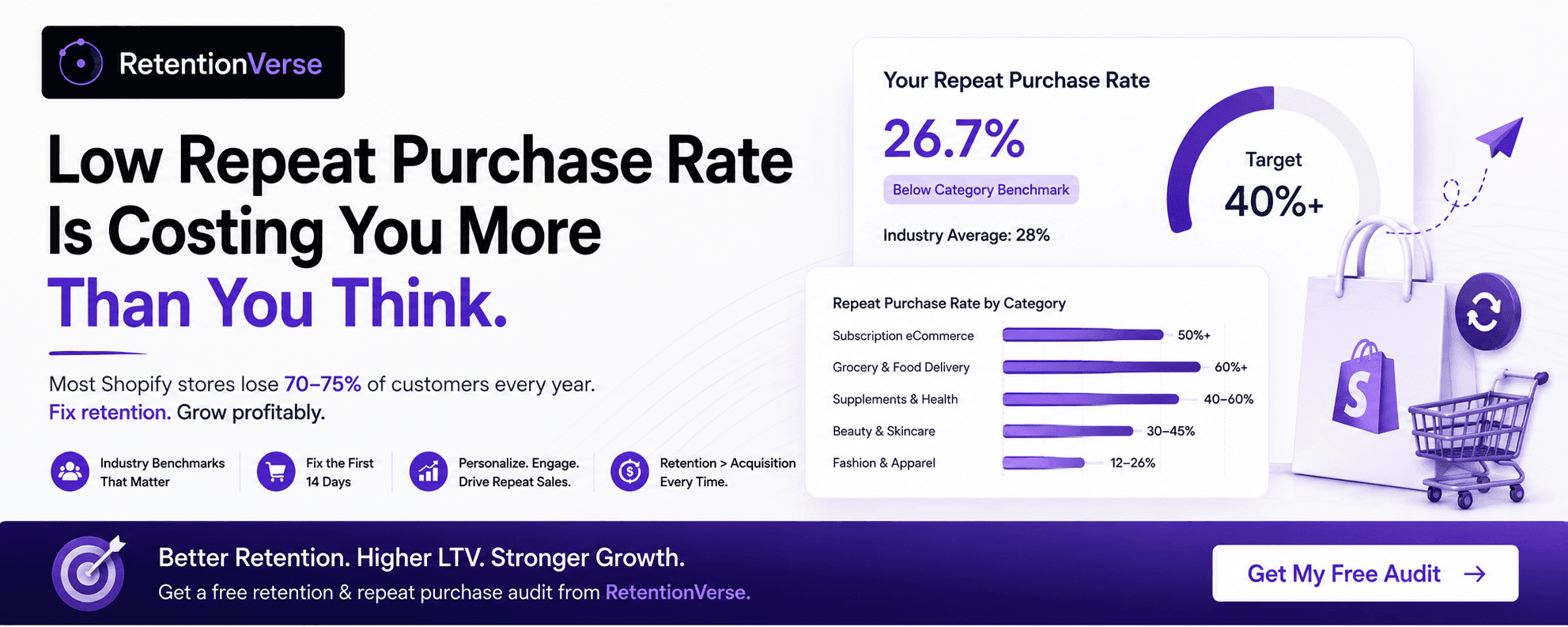
Most Shopify stores lose 70 to 75 percent of their customers every year. For every four people who buy in January, roughly three never come back. That number alone explains why customer acquisition keeps getting more expensive even when the marketing team isn't doing anything wrong. You're not just trying to grow. You're constantly refilling a bucket with a hole in the bottom.
The instinct when repeat purchase rate looks low is to compare it to the industry average, somewhere around 28 percent, and either panic or feel fine depending on which side of that number you land on. Both reactions usually miss the point. The 28 percent figure is a blend across every category from luxury watches to grocery delivery, and comparing your store to it is close to meaningless unless you sell exactly what the average brand sells, which no one actually does.
The Benchmark That Actually Matters Is Your Category, Not the Average
| Category | Typical Repeat Purchase Rate |
|---|---|
| Subscription ecommerce | 50%+ |
| Grocery and food delivery | 60%+ |
| Supplements and health | 40 to 60% |
| Pet supplies | High, driven by predictable replenishment |
| Beauty and skincare | 30 to 45% |
| Fashion and apparel | 12 to 26%, casual wear trending higher within that range |
| Home goods | 20 to 30% |
| Electronics | 10 to 20% |
| Luxury goods | 10 to 15% |
A luxury brand sitting at 12 percent might be performing exactly as expected for its category. A supplements brand at that same 12 percent has a real, fixable problem. Before deciding anything is broken, find where your category actually lands and measure the gap from there, not from the blended average.
A useful rule of thumb: if your rate sits more than 5 percentage points below your category's typical range, the issue is very likely fixable through better post-purchase communication and lifecycle marketing, not a fundamentally flawed product.
How to Calculate It Correctly
Example: 1,200 total customers over the last 12 months, 320 of them ordered more than once.
(320 ÷ 1,200) × 100 = 26.7%
One distinction worth knowing: Shopify's native Returning Customer Rate report measures the share of orders that came from returning customers, which is a related but different number from the percentage of your customer base that has repurchased. Don't treat the two as interchangeable when benchmarking.
Why the Number Is Actually Low
The most common pattern behind a weak repeat purchase rate isn't one dramatic failure. It's usually a combination of lower-intent acquisition and a post-purchase experience that never gives the customer a reason to come back.
| Cause | What's Happening |
|---|---|
| Weak first 14 days post-purchase | No onboarding, no education, no reassurance after the sale, so the customer's experience of the brand ends the moment the box arrives |
| Generic lifecycle messaging | Every customer gets the same broadcast regardless of what they bought or when they're likely to need more |
| No structured reason to return | No loyalty program, no replenishment reminder, no bundle or subscription option nudging a second purchase |
| Acquisition channel mismatch | Certain paid channels bring in lower-intent, one-time buyers at scale, quietly dragging down the blended repeat rate even while total customer count looks healthy |
| No personalization around reorder timing | A supplements brand not messaging around the actual 30-day supply window is leaving the most predictable repurchase moment in the entire business untouched |
Notice that product quality isn't on this list. It can be a factor, but in most audits, the bigger lever is what happens between the first purchase and the moment a second one would naturally make sense, not the product itself.
The First 14 Days Matter More Than Almost Anything Else
This is the part most retention strategies underweight. The period right after a first purchase is when a customer's opinion of the brand is actually forming, and it's also the window most stores do the least with. Reducing friction here, clear shipping updates, simple setup instructions, responsive support if something goes wrong, does more for long-term repeat behavior than almost any discount campaign sent months later.
Perceived value matters just as much as friction reduction. A short, genuine education sequence about the product, not a sales pitch, but real usage guidance and context, tends to build the kind of trust that makes a second purchase feel obvious rather than something that needs to be persuaded into happening.
What Actually Moves the Number
- Diagnose by cohort and channel first. Segment repeat purchase rate by acquisition source and by product category before changing anything. This tells you whether the problem is broad or concentrated in one channel or product line
- Fix the first 14 days. Reduce post-purchase friction and add a short educational sequence that reinforces the value of what was just bought
- Personalize around the actual reorder window, not a generic 30-day follow-up email sent to everyone regardless of what they bought
- Build a structural reason to return. Loyalty programs, replenishment reminders, and bundles all create repurchase behavior instead of hoping a customer remembers to come back on their own. Brands with loyalty programs in place see meaningfully more purchases and notably higher repeat rates than those without
- Measure with a holdout group where possible. Compare repeat purchase behavior between customers who received the improved lifecycle sequence and those who didn't, rather than assuming a change worked just because the overall number moved
Where to Go From Here
A low repeat purchase rate rarely means customers dislike the product. It usually means nothing structured is happening between the first purchase and the moment a second one would make sense. That gap is entirely fixable, and it's typically far cheaper to close than the cost of acquiring enough new customers to make up for the ones quietly walking away.
This is the exact audit RetentionVerse runs for Shopify and DTC brands: repeat purchase rate by cohort and channel, post-purchase flow review, and lifecycle personalization mapped to your actual reorder windows, benchmarked against your specific category instead of a blended industry average.
Get a free retention and repeat purchase audit from RetentionVerse. We'll show you exactly where customers are dropping off after their first order, and what closing that gap is worth per month.
FAQs
What is a good repeat purchase rate for a Shopify store? Most Shopify stores fall between 30 and 40 percent for a solid rate, though the honest answer depends heavily on category. Consumables and supplements often exceed 40 percent, while fashion typically sits between 12 and 26 percent, and luxury goods can be healthy anywhere from 10 to 15 percent.
Why is my repeat purchase rate below the industry average? The blended industry average, around 28 percent, mixes categories with very different natural repurchase behavior. Compare your rate to your specific product category first. If you're still more than 5 percentage points below that category benchmark, it's usually a fixable lifecycle and post-purchase issue rather than a product problem.
Does acquisition channel affect repeat purchase rate? Yes, significantly. Certain paid acquisition channels bring in higher volumes of lower-intent, one-time buyers, which can quietly drag down your blended repeat purchase rate even while total customer count and first-purchase revenue both look healthy. Segmenting by channel usually reveals where the real gap is.
What's the highest-leverage fix for a low repeat purchase rate? Improving the first 14 days after a customer's first purchase tends to have an outsized impact. Reducing friction (shipping clarity, setup ease, responsive support) and adding genuine post-purchase education builds the trust that makes a second purchase feel natural, rather than something that needs to be persuaded into happening later with a discount.
How is repeat purchase rate different from customer retention rate? Repeat purchase rate measures the percentage of customers who have bought more than once within a set period. Customer retention rate measures active status over time and is calculated differently. The two are related but shouldn't be used interchangeably when benchmarking your store.
Written by
Mayur Sadar
Retention Specialist · RetentionVerse
Expert in email & SMS retention systems that turn one-time buyers into loyal, high-LTV customers.