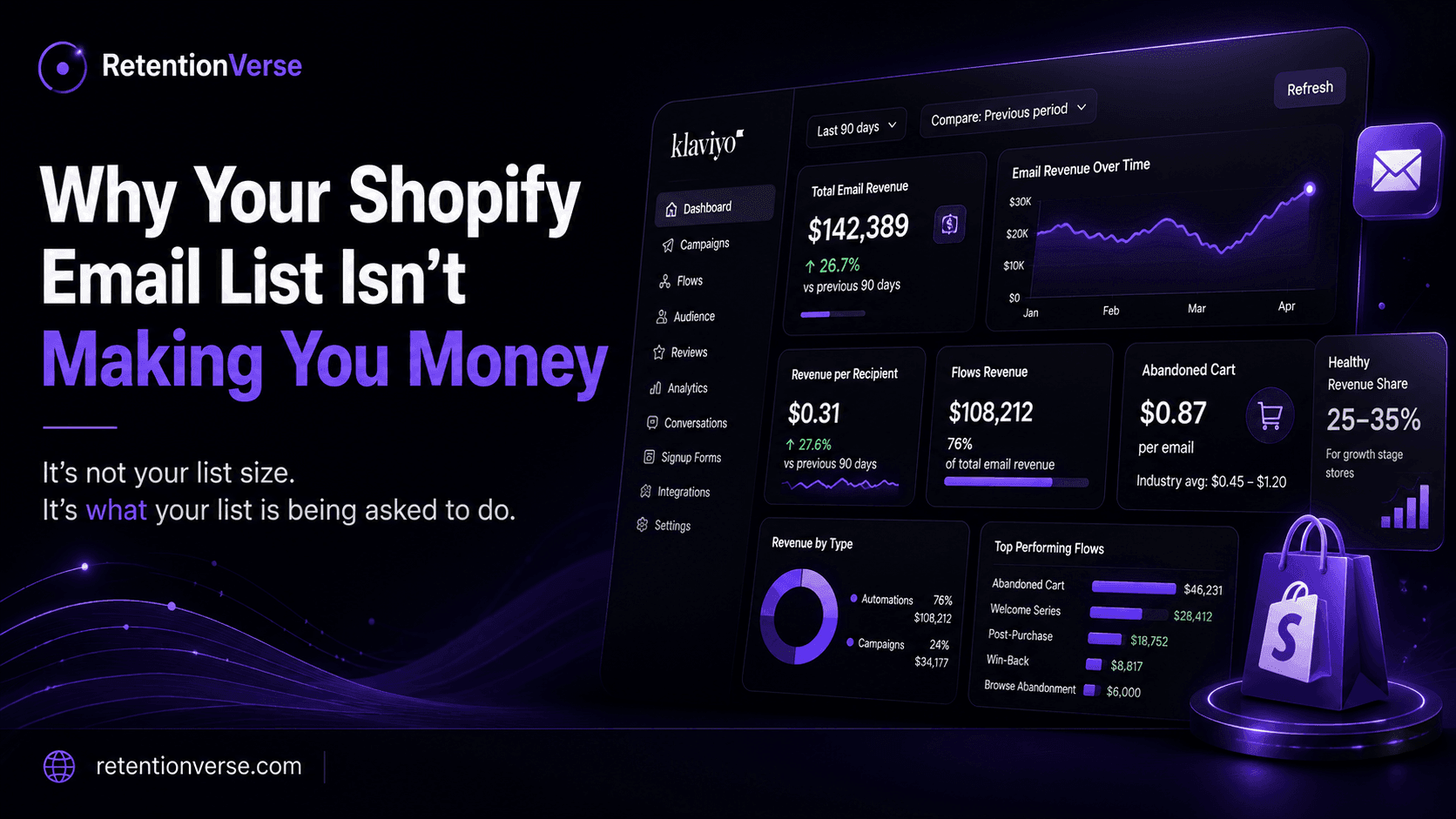
Why Your Shopify Email List Isn't Making You Money
You have thousands of subscribers. You send weekly. Open rates look fine on the dashboard. And somehow email is still contributing single digits to total revenue instead of the 25 to 35 percent it should be carrying for a store your size.
The instinct here is to blame the list. Not enough subscribers, not engaged enough, needs a bigger discount to get people to buy. Almost never true. A list of 50,000 people who joined for a spin-the-wheel discount they never intended to use is worth less than 5,000 people who actually open and click. Size was never the real constraint. What the list is being asked to do, and how it's being measured, usually is.
What "Making Money" Actually Looks Like
Before diagnosing anything, it helps to know the real target, because most stores are benchmarking against the wrong number entirely.
| Store Stage | Healthy Email Revenue Share |
|---|---|
| Early stage, under $30k/month | 8 to 15 percent (list is still being built) |
| Growth stage, $30k to $150k/month | 25 to 35 percent |
| Mature stage, above $150k/month | 22 to 30 percent (paid acquisition takes a larger share) |
| Under 20 percent at growth stage | Usually means flows are broken or the list is unhealthy |
| Over 40 percent consistently | Usually means paid acquisition has stalled, not that email is thriving |
If your store sits well below its stage benchmark, that's the real signal something is off. Not the open rate. Not the subscriber count.
The Metric You're Probably Not Tracking
Open rate became the default email metric because it was the easiest one to see, not because it's the one that predicts revenue. A 45 percent open rate does not mean 45 percent of subscribers are actually opening. Apple Mail Privacy Protection alone inflates reported opens by roughly 8 to 12 percentage points across the industry, and that gap has only gotten harder to untangle since.
The metric that actually tells you whether the program is working is revenue per recipient, total email-attributed revenue divided by total recipients. It's the one number that accounts for list quality, content, and targeting all at once.
| Email Type | Healthy Revenue Per Email/Recipient |
|---|---|
| Campaign emails | $0.10 to $0.20 |
| Automated flow emails | $0.15 to $0.35, often higher for top performers |
| Abandoned cart emails specifically | $0.45 to $1.20, the single highest-value automated email in ecommerce |
If your open rate looks healthy but revenue per recipient is flat or low, the problem was never visibility. It's what happens after the open.
The Real Reasons a List Stops Making Money
| Cause | What It Looks Like |
|---|---|
| Campaign-only strategy | Weekly newsletters with no behavioral flows behind them. Automated flows typically outperform campaigns 3 to 5 times on revenue per email, so skipping them caps the entire channel |
| Missing core flows | No welcome series, cart abandonment, post-purchase, win-back, or browse abandonment sequence live. These five flows are the actual engine, not the newsletter |
| Poor list growth quality | Heavy discount-driven pop-ups bring in subscribers who joined for the code, not the brand, and rarely convert again afterward |
| No segmentation | Same message going to a first-time visitor and a five-time repeat customer. Batch-and-blast sending consistently underperforms behavior-based targeting |
| Deliverability decay | List hygiene and engagement-based sending aren't optional anymore. Poor sender reputation quietly suppresses revenue before a single subscriber even reads the copy |
Notice that a weak subject line isn't on this list either. It rarely is. The gap almost always sits upstream, in what the program is built to do and who it's actually built for.
Why Shopify and Klaviyo Might Show You Two Different Numbers
If you've ever pulled email revenue from Shopify's native dashboard and compared it to Klaviyo's number and gotten two very different answers, that's not a bug. Shopify's dashboard typically only credits email for a sale if the session that converted started directly from an email click. Klaviyo's attribution window is usually more generous, crediting a purchase that happened within a set window after an email interaction, even if the shopper browsed elsewhere first.
Neither number is "wrong." They're answering slightly different questions. What matters is picking one methodology and tracking it consistently over time, rather than panicking over a gap between two tools that were never meant to agree perfectly in the first place.
The Fix Order That Actually Works
- Confirm the five core flows are live, not just built and forgotten: welcome series, cart abandonment, post-purchase, win-back, and browse abandonment
- Check revenue per recipient by flow, not open rate, to see which automations are actually earning their place
- Audit how the list was grown. A deep discount pop-up brings in different subscribers than a genuinely useful lead magnet, and it shows up in long-term engagement
- Segment campaigns by purchase history and lifecycle stage instead of sending the same broadcast to everyone at once
- Review deliverability and sender reputation, since a quietly decaying list can suppress revenue for months before anyone notices the pattern
Where to Go From Here
An email list that isn't making money is rarely a list problem. It's usually a structure problem, missing flows, weak segmentation, or a growth strategy built for opt-ins instead of customers, compounding quietly until the revenue share falls well below what a store this size should be generating.
This is the exact audit RetentionVerse runs for Shopify and DTC brands: flow coverage, revenue per recipient by segment, list quality review, and deliverability health, mapped against where your store actually sits in its growth stage.
Get a free email revenue audit from RetentionVerse. We'll show you exactly where the gap is, and what closing it is worth per month.
FAQs
What percentage of Shopify revenue should come from email? For a growth-stage store between $30k and $150k a month, 25 to 35 percent is the healthy range. Early-stage stores under $30k a month typically sit at 8 to 15 percent while the list is still being built, and that's normal, not a failure.
Why does my open rate look fine but email still isn't making money? Open rate has become an unreliable signal since Apple Mail Privacy Protection began inflating reported opens across the industry. Revenue per recipient is the more accurate metric, since it reflects what happens after the open rather than just whether the email was technically counted as opened.
Is my email list too small to make real money? Rarely. A smaller, genuinely engaged list usually outperforms a large one built through aggressive discount pop-ups. List quality, driven by how subscribers were acquired, tends to matter more than raw subscriber count.
Why do Shopify and Klaviyo show different email revenue numbers? They use different attribution logic. Shopify typically credits email only when a purchase session started directly from an email click, while Klaviyo often uses a broader attribution window. Pick one methodology and track it consistently rather than trying to reconcile the two exactly.
What's the first thing to fix if email revenue is underperforming? Confirm the five core flows, welcome, cart abandonment, post-purchase, win-back, and browse abandonment, are actually live and check revenue per recipient for each one. Most underperforming programs are missing at least one of these entirely, not just running weak campaigns.
Written by
Mayur Sadar
Retention Specialist · RetentionVerse
Expert in email & SMS retention systems that turn one-time buyers into loyal, high-LTV customers.