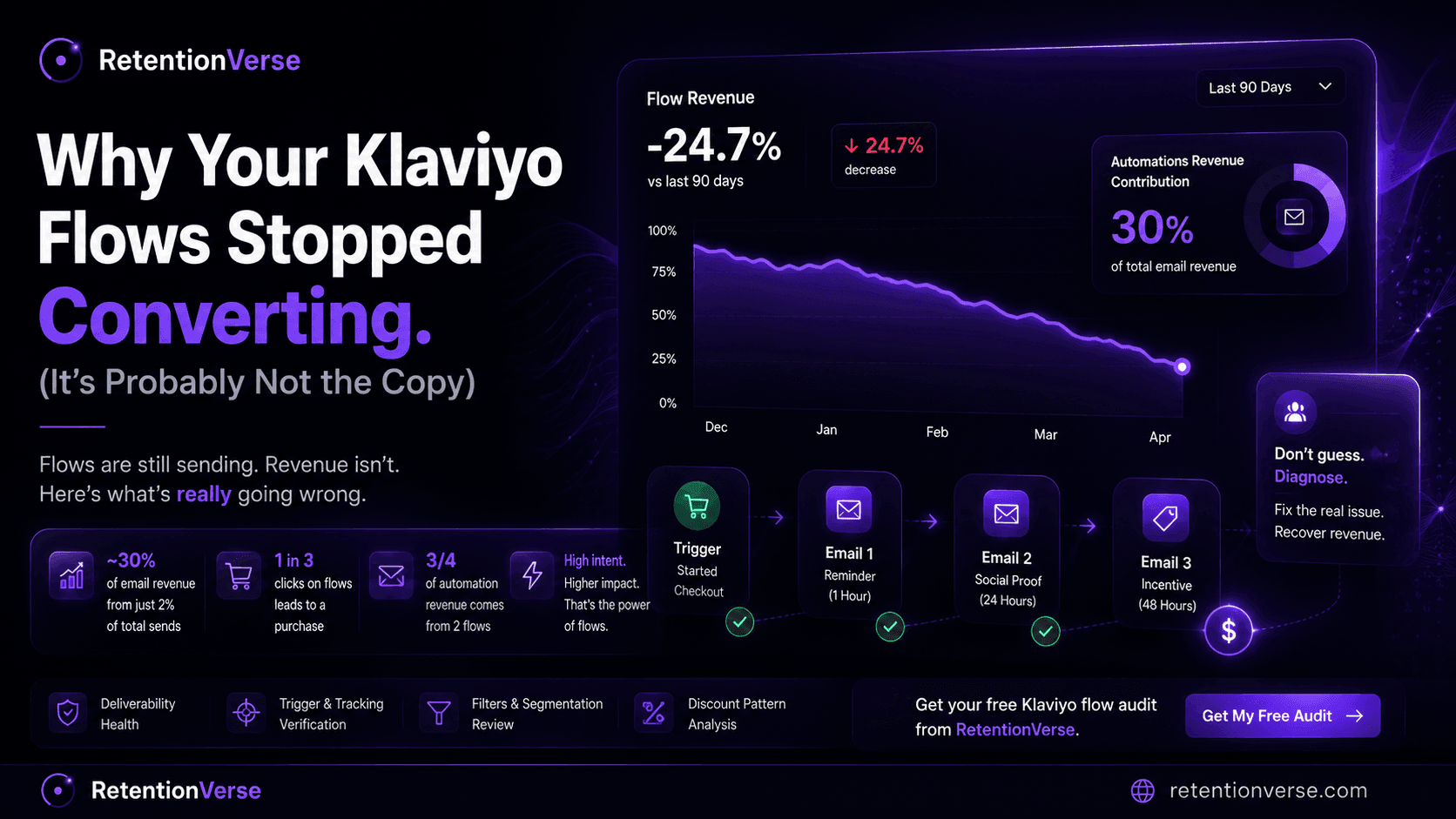
Why Your Klaviyo Flows Stopped Converting (It's Probably Not the Copy)
Your flows are still live. Still sending. Nothing looks broken in the builder. And yet flow revenue has quietly drifted down 10 to 30 percent over the last couple of quarters, and nobody can point to a single change that caused it.
That's the pattern almost every Klaviyo account eventually runs into, and it's rarely one dramatic failure. It's usually five small things compounding at once, none of them alarming on their own, all of them invisible on a standard dashboard until someone finally asks why retention numbers are off.
Here's why flows quietly stop converting, and why rewriting the copy is almost never the fix that actually works.
First, Understand Why Flows Matter So Much
Before diagnosing the problem, it's worth knowing what's actually at stake. Automations typically make up a tiny share of total sends, often around 2 percent, yet they generate roughly 30 percent of total email-driven revenue. Nearly one in three clicks on an automated email results in a purchase, which makes flows one of the strongest buying signals available in the entire channel. Abandoned cart and welcome flows alone typically account for around three-quarters of all automation revenue on their own.
That's exactly why a slow decline in flow performance hurts more than it looks like it should. A small percentage drop in flow conversion touches the highest-leverage part of your entire email program.
The Five Causes That Actually Explain It
| Cause | What's Happening | Why It Goes Unnoticed |
|---|---|---|
| Deliverability drift | Sender reputation slips gradually, more messages land in spam or Promotions | Open rate looks fine in aggregate because Apple Mail Privacy Protection props up the number artificially |
| Trigger drift | Browser-based tracking events like Started Checkout or Added to Cart stop firing reliably | The flow still runs and still looks "live," it's just missing a growing share of the sessions that should enter it |
| Discount conditioning | Customers learn the brand always follows up with a code, so they wait instead of buying at full price | Revenue per recipient falls, but nobody connects it back to the discount pattern in email 3 |
| Missing delivery gates | No filters checking whether a recipient already converted or is sitting in another active flow | Shows up as low engagement or complaints, rarely gets traced back to a filter that was never built |
| Stale segments | Flow logic and audience definitions haven't been touched since launch, while the customer base has shifted | Nothing alerts you to this. It only shows up as a slow decay in flow metrics over time |
Notice that none of these are copywriting problems. That's the point. A flow can have great subject lines and strong creative and still bleed revenue for months if any one of these five is quietly working against it.
The Skipped Message That Looks Like a Broken Flow
One specific confusion trips up almost every Klaviyo user at some point: you check flow analytics, see zero conversions, but the recipient activity log shows messages being skipped with the reason "Has placed order zero times since starting this flow." That skip reason actually means the opposite of what it sounds like. The recipient did convert, which is exactly why later messages in the sequence correctly skipped them. The flow filter is working as intended. It's the attribution window and reporting view that can make a perfectly healthy flow look like it converted nobody.
Before assuming a flow is broken, check the actual skip reasons on individual recipients rather than trusting the summary conversion number alone.
Where to Look Before You Touch Any Copy
- Check the flow status and any warning icons in the Flows tab first. A yellow or red icon next to a flow or a specific email is often the fastest possible diagnosis, and it gets missed constantly because nobody's looking for it
- Review your flow filters. Confirm you're excluding people who already converted, and people currently sitting in another active flow, so a new subscriber isn't hit with three automations in the same hour
- Segment performance by list age. A welcome flow converting long-time engaged customers looks very different from one converting brand-new subscribers, and blending both into one number hides which group is actually the problem
- Look at discount usage over time. If revenue per recipient is falling while discount redemption in your later flow emails is climbing, that's conditioning, not a content problem
- Confirm your trigger events are actually firing at full volume, especially for Added to Cart and Started Checkout, since browser-based tracking scripts are frequently blocked by ad blockers and iOS privacy settings without anyone noticing
The Fix That Pays Back Fastest
For the deliverability piece specifically, the fastest-recovering fix is usually a temporary suppression of recipients with zero engagement in the last 90 days, paired with a short warm-up period at reduced volume to rebuild sender reputation. Revenue from that single fix typically starts recovering within about three weeks, because it directly addresses the thing quietly dragging every other flow down: a sending reputation problem masquerading as a content problem.
Where to Go From Here
The real skill here isn't rewriting a flow. It's being able to look at a revenue dip and name the actual cause in under five minutes instead of defaulting to "let's test new subject lines" for the third quarter in a row. The flows themselves are rarely the hard part. Diagnosing what changed around them is.
This is the exact audit RetentionVerse runs for Shopify and DTC brands: deliverability health, trigger and tracking verification, filter and segmentation review, and discount pattern analysis, mapped against your actual flow data instead of a generic checklist.
Get a free Klaviyo flow audit from RetentionVerse. We'll show you exactly which of these five causes is behind your numbers, and what fixing it is worth per month.
FAQs
Why did my Klaviyo flow revenue drop even though I haven't changed anything? Flow revenue rarely drops because of one dramatic change. It's usually a slow combination of deliverability drift, missing trigger events, discount conditioning, or stale segmentation, all compounding quietly over a few months until someone finally checks the numbers.
My flow shows zero conversions but I know people bought. What's going on? Check the skip reasons in the recipient activity log rather than trusting the summary conversion number. A skip reason like "has placed order" usually means the person already converted, which is why later emails correctly skipped them. The flow is working as designed.
Should I rewrite my flow copy if conversions drop? Not first. Check flow status warnings, filters, trigger volume, and deliverability before touching content. Copy is rarely the actual cause of a flow that's been converting well for months and suddenly isn't.
How much of my email revenue should come from flows? A well-built flow program typically generates 30 to 40 percent of total email revenue, despite automations often making up only a small share of total sends. If flows are contributing far less than that, it's worth auditing the foundational flows before adding new ones.
What's the fastest fix for a flow that's losing revenue to deliverability issues? Suppressing contacts with no engagement in the last 90 days, combined with a short sending warm-up period at reduced volume, typically shows measurable recovery within a few weeks, since it addresses sender reputation directly rather than working around it.
Written by
Mayur Sadar
Retention Specialist · RetentionVerse
Expert in email & SMS retention systems that turn one-time buyers into loyal, high-LTV customers.