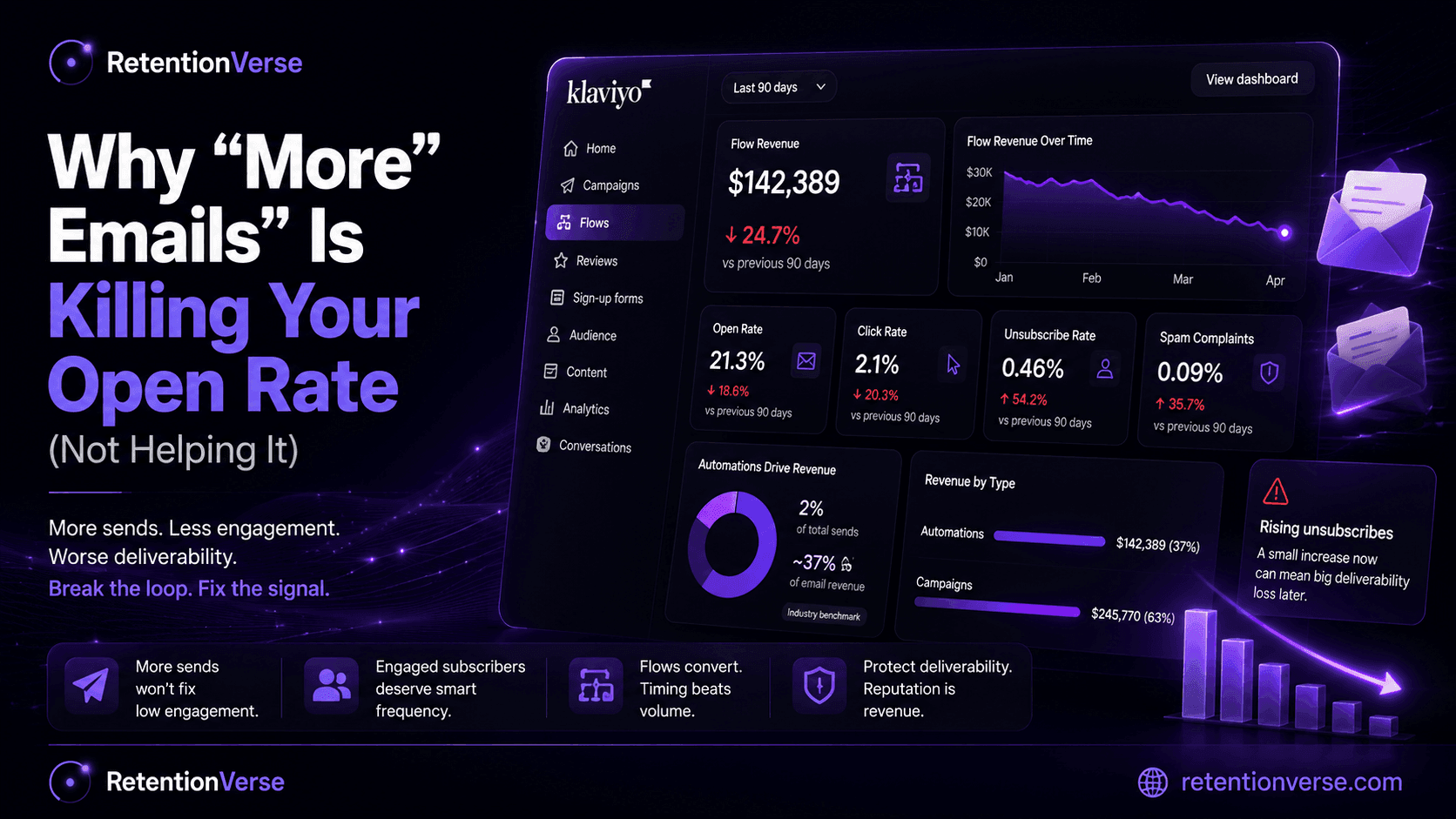
Why "More Emails" Is Killing Your Open Rate (Not Helping It)
The instinct when email revenue stalls is almost always the same: send more. If one weekly campaign isn't moving the needle, try two. If two isn't enough, add a third. It feels like the safe, active response to a flat number, the marketing equivalent of pressing the gas pedal harder.
It's usually the exact move that makes the number worse.
Here's the mechanism nobody explains clearly enough before a brand doubles its send volume and watches deliverability quietly fall apart underneath it.
The Feedback Loop Nobody Sees Coming
Inbox providers like Gmail and Yahoo don't just look at whether an email was delivered. They track how recipients respond to it, opens, clicks, deletes without reading, and increasingly, unsubscribes and spam complaints, and they use those signals to decide where your next email lands. Inbox, Promotions tab, or spam folder.
Increase send frequency without a corresponding increase in list size or genuine interest, and engagement rate per email starts to dilute. The same subscribers who happily opened one email a week now see three, and a portion of them stop opening at all. That dip in engagement percentage is exactly the signal inbox providers use to start filtering you more aggressively. So the next round of emails reaches fewer inboxes. Which drops opens further. Which the team reads as "we need to send more to make up the volume." The loop feeds itself.
This is why a brand can genuinely be sending more valuable content, more often, and still watch every core metric decline in the same quarter.
The Number That Warns You First
Open rate is a lagging, unreliable signal in 2026, thanks to Apple Mail Privacy Protection and Gmail's shifting image-loading behavior. Unsubscribe rate is the one that tells you frequency is the actual problem, and it tends to move before open rate visibly does.
| Signal | Healthy Range | What It Means If It Rises |
|---|---|---|
| Unsubscribe rate (ecommerce) | Roughly 0.15% to 0.35% per send | Frequency, relevance, or list quality has slipped |
| Spam complaint rate | Below 0.08% | Serious deliverability risk, address immediately |
| List growth rate | 2% to 5% per month | If sends are rising faster than list growth, engagement dilution is likely already underway |
A rising unsubscribe rate is one of the earliest, most reliable warning signs in the entire channel, and it's also one of the most ignored, because a 0.1 percentage point shift doesn't feel alarming next to a 10-point open rate swing. It should feel more alarming, not less. Open rate can be distorted by tracking pixel changes outside your control. Unsubscribe rate is a direct, unambiguous statement from a real person that they no longer want to hear from you.
Why "Just Send More" Feels Right and Rarely Is
The logic behind increasing frequency isn't irrational. More sends should mean more chances to convert, in theory. The problem is that email isn't a volume channel the way paid ads can be. A list has a finite tolerance for frequency, and that tolerance is set by the subscriber, not the sender. Cross it consistently and the response isn't neutral, it's actively negative: more unsubscribes, more spam complaints, and a sender reputation that takes weeks to rebuild even after frequency comes back down.
Winback and re-engagement flows are the one context where a naturally higher unsubscribe rate is expected and acceptable, because you're deliberately reaching dormant subscribers to find out who still wants to hear from the brand. Applying that same logic to your entire regular sending cadence is a different decision entirely, and it's the one that quietly wrecks deliverability for everyone else on the list who was still engaged.
What Actually Moves Revenue Instead of Volume
The brands seeing 30 percent-plus of revenue from email aren't the ones sending daily. Automated, behavior-triggered emails make up a small fraction of total send volume, often close to 2 percent, yet they generate a wildly disproportionate share of revenue, close to 37 percent in current benchmark data, because they reach the right person at the moment intent is highest. One in three clicks on an automated email results in a purchase, compared to roughly one in eighteen for scheduled campaigns.
That gap isn't about how often those flows send. It's about who they're sent to and when. A cart abandonment email sent an hour after a real cart abandonment will always outperform a fourth weekly newsletter sent to the entire list regardless of behavior.
The Actual Fix Order
- Check unsubscribe rate trend over the last 6 to 12 sends, not just the current one, to establish what's actually normal for your list before reacting to a single data point
- Segment sending frequency by engagement level. Highly engaged subscribers can often tolerate more volume. Lightly engaged ones usually can't, and sending them the same cadence accelerates the decline
- Prioritize flow coverage over campaign volume. If the five core automated flows, welcome, cart abandonment, post-purchase, win-back, browse abandonment, aren't all live and well-tuned, that's a higher-leverage fix than adding another newsletter
- Suppress genuinely inactive contacts rather than mailing them at the same frequency as your engaged list, since their non-response is actively dragging down the engagement signal ISPs use to judge you
- Treat volume increases as a hypothesis to test on a segment, not a blanket decision applied to the entire list overnight
Where to Go From Here
More emails feels like doing something. Often it's the version of "doing something" that costs the most, because the damage shows up gradually, in reputation and filtering, rather than immediately and visibly the way a single bad campaign would. The brands actually growing email revenue aren't sending more. They're sending to the right segment, at the right moment, and letting behavior decide the volume instead of a content calendar.
This is the exact audit RetentionVerse runs for Shopify and DTC brands: send frequency by segment, unsubscribe and complaint trend analysis, and flow coverage review, so you know whether the fix is more volume, less volume, or better targeting before changing anything.
Get a free email strategy and deliverability audit from RetentionVerse. We'll show you exactly what your list can actually tolerate, and where the real revenue is being left on the table.
FAQs
Does sending more emails always hurt open rate? Not always, but it does whenever send volume increases faster than genuine subscriber interest or list growth. The mechanism is engagement dilution: more sends to the same list means a lower percentage of opens per email, which inbox providers read as a reputation signal and respond to by filtering future sends more aggressively.
What's a healthy unsubscribe rate for a Shopify store? Roughly 0.15% to 0.35% per send is the typical ecommerce range. If that number is trending upward over your last several sends while open and click rates are also falling, frequency or relevance is very likely the cause.
Should I ever increase my email frequency? Yes, but as a segmented, tested decision rather than a blanket change. Genuinely engaged subscribers can often tolerate more volume without issue, while lightly engaged ones usually can't, and applying the same increase to everyone accelerates unsubscribes and deliverability decline for the group that can least afford it.
Is unsubscribe rate more reliable than open rate? In 2026, generally yes. Open rate has been distorted by Apple Mail Privacy Protection and changes to how Gmail loads images, while unsubscribe rate is a direct, unambiguous action from a real subscriber and tends to move before open rate visibly reflects a real problem.
What should I fix before increasing send volume? Confirm your five core automated flows, welcome, cart abandonment, post-purchase, win-back, and browse abandonment, are live and performing well. These generate a disproportionate share of revenue relative to their send volume, and they're almost always a higher-leverage fix than adding another campaign to the calendar.
Written by
Mayur Sadar
Retention Specialist · RetentionVerse
Expert in email & SMS retention systems that turn one-time buyers into loyal, high-LTV customers.