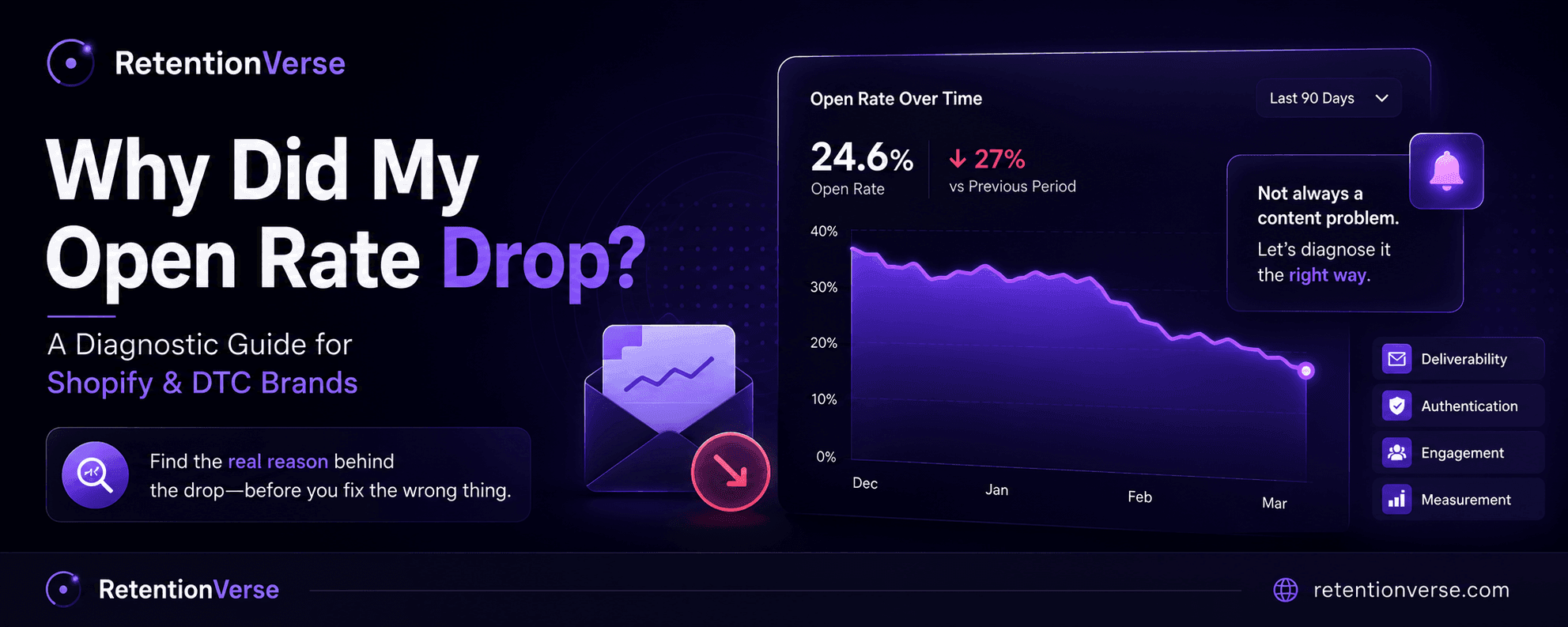
Why Did My Open Rate Drop? A Diagnostic Guide for Shopify and DTC Brands
You open your Klaviyo dashboard, see open rates down 10, 20, sometimes 30 points from last quarter, and immediately assume something is broken. Bad subject lines. A tired list. Something you did.
Here's the part almost nobody tells you first: in 2026, a big chunk of that drop might not be real at all. It might just be your reporting getting more honest.
Before you rewrite a single subject line, it's worth working through this in order, because the fix for "my open rate dropped because Gmail changed how it counts opens" is completely different from the fix for "my open rate dropped because I'm landing in spam." Treating both the same way wastes weeks and usually makes the real problem worse.
Step 1: Figure Out If the Drop Is Even Real
Open rate has never been a perfectly accurate metric, and it's gotten shakier over the last two years for reasons that have nothing to do with your content or your list.
Apple Mail Privacy Protection pre-loads tracking pixels automatically for roughly half of all email opens, which inflated open rates for years before Apple adjusted its filtering and many senders saw sudden, unexplained drops with no campaign changes behind them. More recently, deliverability analysts have been tracking a separate shift on Gmail, where reduced image prefetching means fewer tracking pixels fire even when a subscriber genuinely opens the email. If that theory holds, your real readership could be stable while your reported open rate quietly falls anyway.
Gmail also changed its Promotions tab sorting from chronological to relevance-based in late 2025, which pushes emails from less-engaged senders further down the feed by default. And starting in early 2026, Gmail's AI-generated summaries give some subscribers everything they need without ever opening the email at all.
None of that means you're off the hook. It means open rate alone can't tell you what's actually happening. Clicks and conversions can.
| Signal | What It Suggests |
|---|---|
| Open rate dropped, clicks and conversions held steady | Likely a measurement or tracking change, not a real engagement problem |
| Open rate, clicks, and conversions all dropped together | Real decline, almost always deliverability or list quality |
| Drop is sudden and isolated to Gmail or Microsoft addresses | Provider-specific deliverability issue |
| Drop is gradual and consistent across every provider | Genuine engagement decay, usually list fatigue or segmentation problems |
Step 2: If Clicks Dropped Too, It's Deliverability Before It's Content
This is the part most marketing teams get backwards. The instinct when open rate falls is to test subject lines. But subject line testing can't fix a message that's landing in spam, because a dashboard can't tell the difference between "delivered to the inbox" and "delivered to the junk folder." Both show up as delivered.
A sudden drop of 30 to 50 percent with no changes to your sending pattern is a strong signal you're dealing with inbox placement, not content fatigue. Before touching copy, check:
- Authentication records. Missing or misconfigured SPF, DKIM, and DMARC now trigger real deliverability problems with Gmail and Yahoo, and the symptoms look identical to declining engagement
- Domain and sender reputation, using Google Postmaster Tools if a meaningful share of your list is on Gmail
- Spam complaint rate, which climbs quietly when frequency creeps up faster than your list's tolerance for it
Step 3: The Five Root Causes, Ranked by How Often They're the Real Answer
| Cause | What It Looks Like | How Common |
|---|---|---|
| Engagement dilution | List grew fast through pop-ups or giveaways, diluting the average engagement rate | Very common |
| Deliverability degradation | Authentication issues, poor sender reputation, spam folder placement | Very common |
| Volume creep | Sending frequency increased gradually without anyone deciding it should | Common |
| Segmentation and lifecycle misalignment | Same message going to new subscribers and long-time customers alike | Common |
| Measurement distortion | Apple MPP, Gmail pixel changes, image-blocking clients | Increasingly common, easy to mistake for a real problem |
Notice that "boring subject lines" isn't even on this list. Copy quality matters, but it's rarely the reason a healthy program suddenly craters. It's usually one or more of the five causes above, quietly compounding.
Step 4: Segment the Diagnosis by List, Not Just by Metric
A blended open rate hides which part of your list is actually the problem. Before deciding on a fix, split the numbers by:
- New subscribers versus long-tenured contacts. A list that's been mailed the same way for two years often has a very different decay curve than someone who joined last month
- Gmail versus Apple Mail versus everyone else. Provider-specific drops point to deliverability. Universal drops across every provider point to real engagement decay
- Flow emails versus campaign sends. If your flows (welcome, abandoned cart, post-purchase) are holding steady but campaigns are sliding, the issue is closer to list fatigue from broadcast frequency than a technical problem
What to Actually Fix, In Order
- Verify authentication (SPF, DKIM, DMARC) is properly configured, especially if you haven't checked it in the last 6 to 12 months
- Pull Google Postmaster Tools data if Gmail makes up a meaningful share of your list
- Compare clicks and conversion trends against open rate trends before concluding anything is actually broken
- Suppress genuinely inactive contacts rather than continuing to mail them at the same frequency as your engaged list
- Only after all of that, revisit subject lines, send times, and content, because at that point you're optimizing a healthy list instead of trying to patch a technical problem with better copywriting
Where to Go From Here
A dropping open rate feels urgent because it's the first number most dashboards surface. But treating it as the headline metric, rather than a symptom, is how brands end up spending weeks A/B testing subject lines on a list that was never actually reading the emails to begin with, because they were landing in spam the whole time.
This is the exact diagnostic RetentionVerse runs for Shopify and DTC brands: authentication and deliverability audit, list segmentation review, and lifecycle mapping, so you know whether you're looking at a real engagement problem or a measurement shift before changing a single subject line.
Get a free email deliverability and retention audit from RetentionVerse. We'll show you exactly what's behind your numbers, and what fixing it is worth per month.
FAQs
Why did my open rate suddenly drop with no warning? A sudden, sharp drop with no change in your sending pattern usually points to a deliverability issue, such as spam folder placement or an authentication problem, rather than a content issue. Check whether clicks and conversions dropped proportionally before assuming your content is the cause.
Is a lower open rate always a bad sign? Not always. Changes at Gmail and Apple around image prefetching and tracking pixels have made open rate a less reliable measure of real engagement since 2025. If clicks and conversions have stayed steady while only open rate fell, your actual readership may be unchanged.
Should I fix subject lines first if open rate drops? No. Subject line testing can't fix a deliverability problem, and testing it first usually wastes time while the real issue, often authentication or sender reputation, continues to get worse. Rule out deliverability before touching content.
How do I know if my open rate drop is Gmail-specific? Segment your open rate data by email provider. If the decline is concentrated in Gmail or Microsoft addresses specifically, that points to a provider-level deliverability or filtering issue rather than a broad engagement problem across your whole list.
What's a good email open rate in 2026? There isn't a single universal number, since open rate tracking varies significantly by list composition and provider mix. The more useful benchmark is internal: whether your open rate correlates with stable clicks and conversions over time, not whether it matches an industry average.
Written by
Mayur Sadar
Retention Specialist · RetentionVerse
Expert in email & SMS retention systems that turn one-time buyers into loyal, high-LTV customers.