SMS Marketing for Shopify Stores: The 2026 Playbook for Turning Texts Into Real Revenue
Every Shopify store owner eventually gets pitched the same stat: SMS gets a 98 percent open rate. It's true, and it's also the least useful fact in the entire channel, because open rate has nothing to do with whether someone actually buys.
The stores making real money from SMS aren't the ones sending the most texts. They're the ones sending fewer messages, at better moments, to people who actually asked for them. Everyone else is slowly training their list to ignore the brand or, worse, unsubscribe entirely.
Here's what actually separates a Shopify SMS program that pays for itself from one that just adds noise.
The Real Numbers Behind SMS in 2026
Before touching strategy, it helps to know what "good" looks like, because most merchants are benchmarking against vibes instead of data.
| Metric | Typical Benchmark |
|---|---|
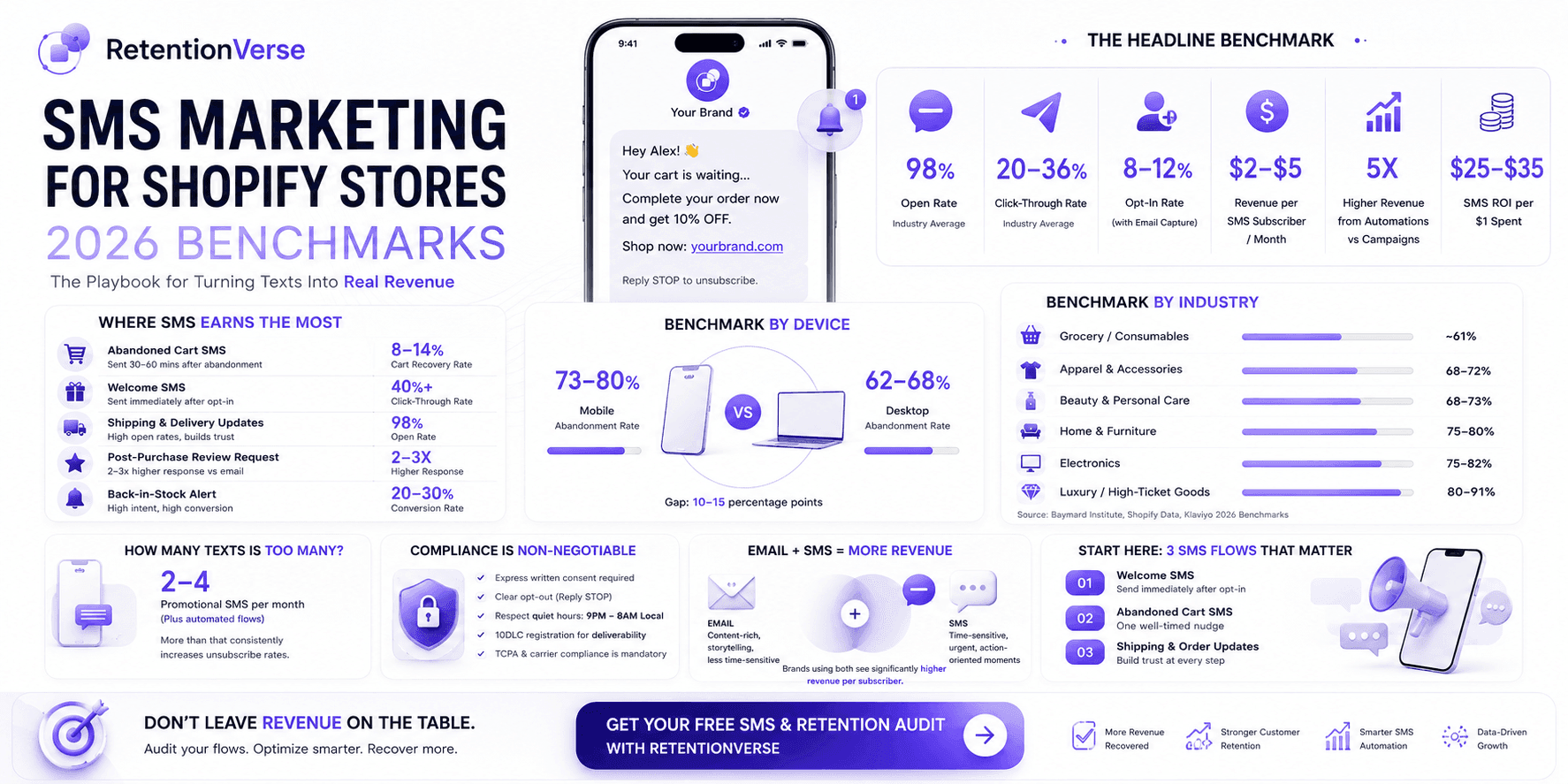
| SMS open rate | Around 98 percent |
| SMS click-through rate | 20 to 36 percent |
| SMS opt-in rate (paired with email capture) | 8 to 12 percent |
| Revenue per SMS subscriber, monthly | $2 to $5 |
| SMS automation revenue per send | Roughly 5 times higher than campaign sends |
| Email ROI per dollar spent | Around $36 to $42 |
| SMS ROI per dollar spent | Around $25 to $35 |
Two things jump out here. First, SMS wins on engagement by a wide margin over email. Second, email still wins on raw ROI per dollar spent. SMS isn't meant to replace email. It's meant to catch the small number of moments where speed matters more than depth, and email can't do that job as well.
Where SMS Actually Earns Its Keep
Automated, behavior-triggered SMS consistently outperforms one-off promotional blasts, sometimes by a wide margin.
| SMS Flow | Typical Performance |
|---|---|
| Welcome SMS (sent immediately after opt-in) | Highest-converting SMS type, often 40 percent plus click-through |
| Abandoned cart SMS (sent around 30 to 60 minutes after) | Recovers roughly 8 to 14 percent of abandoned carts |
| Shipping and delivery updates | Near-universal open rates, builds trust rather than driving direct sales |
| Post-purchase review request | Response rates often 2 to 3 times higher than the same ask by email |
| Back-in-stock alert | High intent, since the person already wanted the product |
Notice the pattern. Every flow on this list is tied to something the customer is already expecting or already wants. None of them are cold promotional blasts. That's the actual formula, not a coincidence.
How Many Texts Is Too Many
This is where most brands get greedy and pay for it later. A reasonable frequency for promotional SMS campaigns is two to four messages per month, on top of transactional and automated flow messages like shipping updates or cart recovery. Push past that consistently and unsubscribe rates start climbing faster than revenue does.
A simple gut check before sending: would this text feel useful if it landed on your own phone from a brand you like, or would it feel like an interruption? SMS is a more personal channel than email lives in. People forgive a promotional email they don't care about. A text message sitting next to messages from their family feels different, and they'll unsubscribe over it much faster.
Getting Compliance Right (Non-Negotiable)
SMS marketing in the US is regulated under TCPA and carrier-level guidelines, and the penalties for getting this wrong aren't theoretical. A few rules that aren't optional:
- Express written consent is required before sending any marketing text, and it has to be collected separately from email consent, not bundled silently into a checkbox
- Every marketing message needs a clear opt-out instruction, typically "Reply STOP to unsubscribe"
- Quiet hours apply. Sending between 9pm and 8am in the recipient's local time zone is a compliance risk, not just a bad look
- 10DLC registration matters more than most merchants realize. Poor registration and carrier filtering quietly tank deliverability before a single customer even sees the message
Skipping this section to get to "the fun part" is exactly how brands end up with a list that technically exists but barely delivers.
SMS and Email Aren't Competing, They're Splitting the Job
The stores getting this right stop treating SMS as "email but shorter" and start treating it as a different tool for a different moment.
Email carries the content-rich communication: product launches, newsletters, storytelling, anything that benefits from visuals and a bit of space. SMS handles the time-sensitive, action-oriented moments: a flash sale closing in a few hours, a cart sitting abandoned right now, a restock that just happened. Brands running both channels in a coordinated way, rather than as two separate silos, tend to see meaningfully higher revenue per subscriber than brands leaning on just one.
Where Most Shopify Stores Should Actually Start
If SMS isn't set up yet, the instinct is usually to build everything at once. That's the wrong order. The highest-value starting point is almost always three flows:
- Welcome SMS, triggered immediately after opt-in, while intent is highest
- Abandoned cart SMS, sent as a single, well-timed nudge, not a full sequence
- Order and shipping updates, which build trust even though they're not designed to sell anything directly
Once those three are live and performing, layering in back-in-stock alerts, VIP or early-access texts, and review requests makes sense. Building all of it on day one, before you even know what your list tolerates, is how brands burn through goodwill in month one.
The Mistake That Quietly Caps Every SMS Program
Most SMS strategy advice focuses on copywriting: keep it short, use the customer's name, add urgency. That's not where the real gap is. The real gap is treating SMS list growth as an afterthought bolted onto an email popup, rather than its own intentional acquisition channel.
Brands that pair email and phone number capture at the same moment, with a clear reason to hand over a phone number (not just a generic discount), consistently see stronger opt-in rates and a healthier list from day one. A list built lazily, just phone numbers vacuumed up without real consent context, is the single biggest reason brands see high unsubscribe rates a few months in. The problem isn't usually the messages. It's who's on the list and why they joined in the first place.
Where to Go From Here
SMS is one of the highest-leverage channels available to a Shopify store right now, but only when it's built around real customer behavior instead of a generic app install and a default template. The brands seeing $25 to $35 back per dollar spent aren't sending more texts than everyone else. They're sending fewer, better-timed ones to a list that actually wants to hear from them.
This is the exact setup RetentionVerse builds for Shopify and DTC brands: compliant list growth, flow sequencing that matches customer intent, and SMS layered into the broader lifecycle strategy instead of bolted on as an afterthought.
Get a free SMS and retention audit from RetentionVerse. We'll show you exactly where your current setup is leaving revenue on the table, and what a properly sequenced SMS program is worth for your store.
FAQs
Is SMS marketing worth it for a small Shopify store? It's usually worth adding once a store has an established email program and at least a few hundred engaged subscribers to message. Below that, email tends to deliver more value per hour invested, since it's cheaper to run and handles more of the customer journey.
How many SMS messages should a Shopify store send per month? Two to four promotional messages per month is a reasonable ceiling, in addition to automated flow and transactional messages like shipping updates. Going meaningfully higher on a consistent basis tends to increase unsubscribe rates faster than it increases revenue.
What's the best first SMS automation to set up? A welcome SMS triggered right after opt-in typically converts the highest of any SMS flow, since intent is at its peak the moment someone subscribes. Abandoned cart and shipping update flows are the next two worth prioritizing.
Do SMS and email marketing compete with each other? Not when they're set up correctly. Email handles content-rich, less time-sensitive communication, while SMS handles urgent, action-oriented moments like a closing sale or an abandoned cart. Brands running both together tend to see notably higher revenue per subscriber than brands relying on just one channel.
What's the biggest compliance risk in Shopify SMS marketing? Collecting phone numbers without clear, separate consent from email opt-in, and skipping proper 10DLC registration. Both mistakes lead to poor deliverability and real regulatory risk under TCPA, regardless of how good the message copy is.
Written by
Mayur Sadar
Retention Specialist · RetentionVerse
Expert in email & SMS retention systems that turn one-time buyers into loyal, high-LTV customers.