Klaviyo Win-Back Flow: How to Re-Engage Lapsed Shopify Customers (Before You Lose Them for Good)
Every Shopify store has a segment sitting quietly in Klaviyo that nobody's looking at. Customers who bought once, maybe twice, and then just stopped. Not unsubscribed, not complained, just gone quiet. Most brands write that segment off entirely and pour the entire budget into acquiring someone new instead.
That's usually the wrong call. Reactivating a lapsed customer typically costs a fraction of what it takes to acquire a new one, roughly five times cheaper by most estimates, because you're not paying to build trust from zero. They already bought. They already know the product works. Something just let the relationship go cold, and in most cases, nobody ever asked them to come back.
A win-back flow is the systematic version of asking. Here's how to build one that actually reactivates people instead of just adding another email nobody opens.
Define "Lapsed" With an Actual Number, Not a Guess
The single biggest mistake in win-back flows is using a generic timeframe borrowed from a template instead of anchoring it to how your specific product gets repurchased. A supplement brand and a furniture brand should never use the same dormancy window.
| Product Category | Typical Repurchase Cycle | Suggested Lapsed Threshold |
|---|---|---|
| Consumables (supplements, coffee, skincare) | 30 to 60 days | 60 to 90 days without a repeat order |
| Apparel and fashion | Seasonal | 90 to 180 days |
| Beauty and personal care | 60 to 90 days | 90 to 120 days |
| Home goods and durable products | 6 to 18 months | 6 to 12 months without a repeat order |
Set the threshold too short and you'll catch customers who were never going to buy again this soon anyway, which just adds noise. Set it too long and the relationship has already gone cold by the time the flow fires. Anchor the number to your own median repurchase interval in Klaviyo or Shopify analytics, not an industry default.
It's also worth splitting the pool by more than just recency. A customer who ordered twice and went quiet for 100 days is a different conversation than someone who ordered once, three months ago, and never came back. The first is at-risk. The second is closer to genuinely lapsed. They deserve different tones and different offers, not the same flow.
The Sequence Structure That Actually Converts
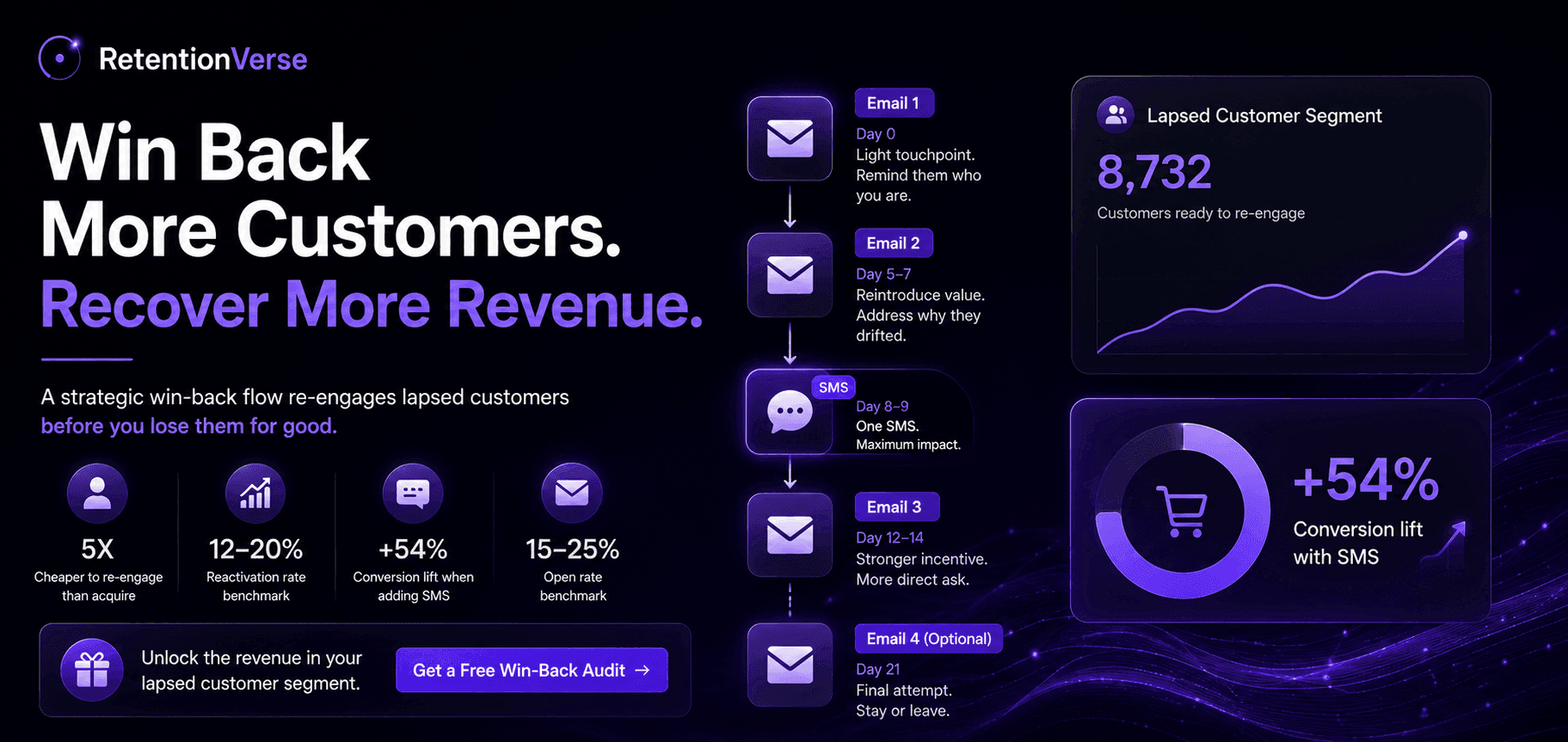
Three to four emails is the workhorse structure most Klaviyo win-back flows should follow. Beyond that, you're mailing into diminishing returns and rising unsubscribe risk for very little additional reactivation.
| Timing | Purpose | Tone | |
|---|---|---|---|
| Email 1 | Day 0 (trigger date) | Light touchpoint, remind them who you are | Short, no hard sell, showcase 3 to 6 bestsellers |
| Email 2 | Day 5 to 7 | Moderate incentive, reintroduce value | Warmer, address why they might have drifted |
| Email 3 | Day 12 to 14 | Stronger incentive, more direct ask | Direct but not desperate |
| Email 4 (optional) | Day 21 | Final attempt, "stay or leave" framing | Give a lower-commitment option, like reduced send frequency, instead of losing them entirely |
That fourth email does double duty. It's a last conversion attempt, but it also manages unsubscribe risk by offering something less final than a full opt-out, like moving to quarterly emails instead of weekly ones. A customer who chooses reduced frequency over unsubscribing is still reachable later. One who unsubscribes usually isn't.
What Realistic Performance Actually Looks Like
Win-back flows have the lowest engagement of any flow type in most Klaviyo accounts, and that's expected, not a sign something's broken. You're deliberately messaging people who already disengaged once.
| Metric | Realistic Benchmark |
|---|---|
| Open rate | 15 to 25 percent (versus 30 to 45 percent for an actively engaged list) |
| Click rate | 3 to 8 percent |
| Per-email conversion rate | 0.9 to 1.4 percent of recipients |
| Full-program reactivation rate | 12 to 20 percent of the lapsed segment, top-quartile brands reach 20 to 35 percent |
Those numbers look small next to a cart abandonment flow's benchmarks, and that's the point of comparing them at all. A win-back flow was never going to convert like a high-intent abandoned cart email. What makes it worth building is the size of the audience it's reaching. A 5 percent conversion rate against a segment of 10,000 dormant customers is 500 recovered customers that a "we've written them off" strategy would have left on the table entirely.
There's also a second payoff that doesn't show up in the conversion number directly. Roughly 45 percent of people who open a win-back email go on to resume opening future campaigns, even if they don't buy immediately from that specific flow. Reactivating attention is worth almost as much as reactivating a purchase, since it keeps that customer inside the broader lifecycle engine instead of sitting permanently dormant.
Add SMS If You Want a Real Lift
Layering SMS into a win-back sequence isn't just a nice-to-have. Adding a single, well-placed SMS touch to an email win-back flow has been shown to lift conversion by roughly 54 percent compared to email alone, largely because a text lands somewhere an email can easily get buried or filtered. Keep it to one message in the sequence, ideally between the second and third email, rather than running a parallel SMS sequence alongside the full email flow.
Mistakes That Quietly Sink Win-Back Performance
- Using the same dormancy threshold for every product category, instead of anchoring it to actual repurchase behavior
- Leading with a steep discount in email 1, which trains even active customers to expect a deal every time they go quiet
- Treating every lapsed customer identically, rather than separating at-risk (recent, multiple orders) from truly lapsed (single order, long gone)
- Running more than four emails, which mostly just increases complaint and unsubscribe risk without meaningfully improving reactivation
- Never sunsetting genuinely unengaged contacts after the flow completes, which quietly drags down sender reputation for every other flow in the account
Where to Go From Here
A dormant customer list isn't dead weight sitting in Klaviyo doing nothing. It's a lower-cost, higher-trust audience that most brands simply never ask to come back. The gap between a store that ignores this segment and one that runs a properly sequenced win-back flow is often a meaningful, measurable slice of revenue that was always available, just never collected.
This is the exact program RetentionVerse builds for Shopify and DTC brands: dormancy threshold analysis based on real repurchase data, segmented flow logic for at-risk versus fully lapsed customers, and SMS layering, mapped against your actual customer data instead of a generic template.
Get a free win-back and retention audit from RetentionVerse. We'll show you exactly how much revenue is sitting dormant in your lapsed customer segment, and what recovering it is worth per month.
FAQs
How do I know when a customer counts as "lapsed"? Anchor it to your product's natural repurchase cycle rather than a generic number. Consumables typically warrant a 60 to 90 day window, apparel 90 to 180 days, and durable goods 6 to 12 months. Pull your own median repurchase interval from Klaviyo or Shopify analytics for the most accurate threshold.
What's a good reactivation rate for a win-back flow? A healthy program typically reactivates 12 to 20 percent of the lapsed segment overall, with top-quartile brands reaching 20 to 35 percent. Individual emails within the sequence convert much lower, often under 1.5 percent each, which is normal since the total program effect compounds across multiple touches.
Should I offer a discount in a win-back flow? Save the strongest incentive for the later emails in the sequence rather than leading with a steep discount immediately. Starting too aggressively trains customers to expect a deal every time they go quiet, which undermines full-price purchases going forward.
Does adding SMS to a win-back flow actually help? Yes, meaningfully. A single, well-placed SMS touch added to an email win-back sequence has been shown to lift conversion by roughly 54 percent compared to email alone, since text messages are less likely to get buried the way an email can.
Why is my win-back flow's open rate so much lower than my other flows? That's expected, not a sign of a broken flow. Win-back flows target people who already disengaged, so open rates in the 15 to 25 percent range are normal, compared to 30 to 45 percent for an actively engaged list. The flow's value comes from the size of the dormant audience it reaches, not from matching the engagement of your warmest segment.
Written by
Mayur Sadar
Retention Specialist · RetentionVerse
Expert in email & SMS retention systems that turn one-time buyers into loyal, high-LTV customers.