Klaviyo Abandoned Cart Flow Best Practices: The 2026 Playbook That Actually Recovers Revenue
Here's an uncomfortable truth. Most Shopify brands already have an abandoned cart flow in Klaviyo. It's just quietly underperforming: three generic emails, one built-in template, no real strategy behind any of it. Nobody's checking the numbers closely enough to notice.
That's the expensive part. Not the absence of a flow. The presence of a mediocre one that everyone assumes is handled.
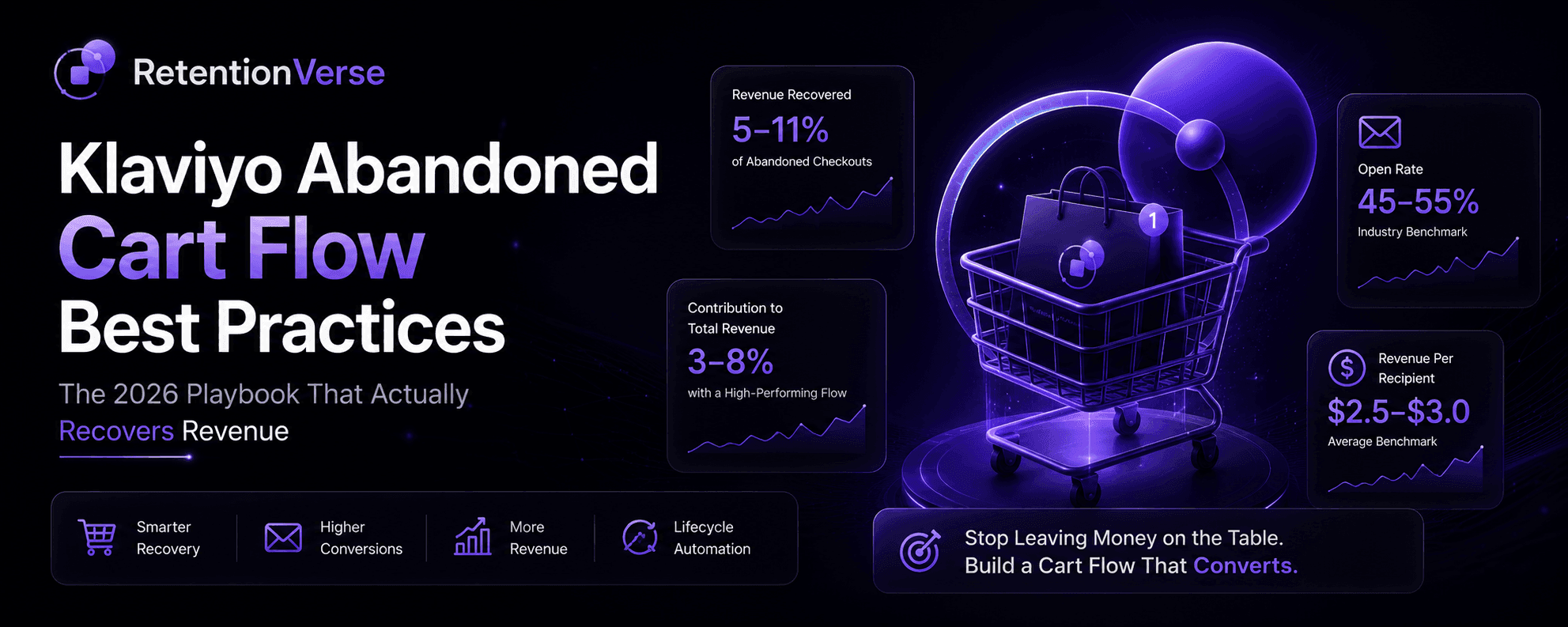
A properly built Klaviyo abandoned cart flow is, on a per-hour-invested basis, one of the highest-ROI automations in ecommerce. Done right, it recovers 5 to 11 percent of abandoned checkouts and quietly contributes 3 to 8 percent of total store revenue once it matures. Done wrong, it still sends emails. It just sends them to the wrong people, at the wrong time, with the wrong message, and nobody finds out because "the flow is live" looks the same in both cases.
This is the playbook we use when we rebuild abandoned cart flows for Shopify and DTC brands. No filler, no "just add urgency" advice. Just the structure, timing, filters, and copy decisions that actually move the revenue-per-recipient needle.
Step 1: Pick the Right Trigger
Before a single email gets written, you have to decide what event starts the flow. This single decision sets your ceiling.
| Trigger | Fires When | Who You Can Email | Recovery Potential |
|---|---|---|---|
| Started Checkout | Shopper enters the checkout page (Information step) | Anyone. They've already given an email address, subscribed or not | High. This is the recommended primary trigger |
| Added to Cart | Shopper adds a product but never reaches checkout | Only shoppers already known to Klaviyo (subscribers, past customers) | Lower reach, but valuable as a secondary flow |
Most default setups run on Added to Cart because it's the flow Shopify nudges you toward first. The problem is that it can only message people Klaviyo already recognizes. Started Checkout is the trigger nearly every high-performing setup uses as the primary flow, because intent is higher and Klaviyo can legally email the shopper regardless of subscription status. They handed over their email the moment they started checkout.
Best practice: run both. Started Checkout as your primary, revenue-driving flow. Added to Cart as a secondary flow targeting only known or subscribed shoppers who added a product but never got as far as checkout. Treat that one as a warmer, more casual re-engagement rather than a hard sell.
Step 2: Get Your Flow Filters Right
This is the unglamorous part nobody screenshots for a case study, and it's exactly where flows quietly fail. Before the first email sends, your flow needs filters that exclude:
- Anyone who already completed the order (obvious, but frequently missed when flows are duplicated from a template)
- Anyone currently sitting in another flow, such as Welcome Series or Browse Abandonment, so a new subscriber isn't hit with three different automations in the same hour
- Anyone who purchased through an alternate checkout path, like Buy with Prime or Shop Pay Installments, that wouldn't register as a normal Placed Order event
- Unsubscribed or suppressed profiles. Klaviyo handles this by default, but check it again after any list cleanup
Skipping this step is how a shopper who just bought your product ends up getting a "still thinking it over?" email forty minutes later. Small technical detail, outsized trust cost.
Step 3: Nail the Timing
"Send the first email 4 hours after abandonment" is the advice you'll find everywhere, and it's a fine starting point. But it's a default, not a strategy. A better approach anchors timing to your Average Order Value, since AOV is a decent proxy for how long a shopper actually needs to decide.
| Timing (Standard AOV) | Timing (High AOV, $150+) | Purpose | |
|---|---|---|---|
| Email 1 | 1 to 4 hours after abandonment | 3 to 6 hours | Reminder plus cart contents, zero pressure |
| Email 2 | 24 hours after abandonment | 24 to 48 hours | Address objections: shipping, returns, reviews |
| Email 3 | 48 to 72 hours after abandonment | 72 to 96 hours | Urgency or incentive, last touch |
| Email 4 (optional) | Not typically needed | 5 to 7 days | Final nudge, only for genuinely high-consideration purchases |
Two notes that matter more than the exact hour you pick:
First, don't send the first email too fast. Anything under roughly one hour and fifteen minutes risks firing before checkout and inventory sync fully settle, so you end up emailing someone about a cart that's already changed or a payment that already went through.
Second, a fourth email is a high-AOV tool, not a default. For lower-ticket products, a fourth touch usually reads as pushy rather than helpful. Three is the ceiling for most stores.
Step 4: Structure the Content So Each Email Has One Job
The biggest content mistake is writing three versions of the same email. Each message in the sequence should do something the previous one didn't.
Email 1, the reminder. Just the facts: what's in the cart, a clear path back, dynamic product imagery. This shopper may have simply gotten distracted, so treat it like a helpful nudge rather than a sales pitch. A short line of product context, why this item, what problem it solves, tends to outperform a bare product photo and a "complete your order" button.
Email 2, the objection handler. This is where the real recovery work happens, because most abandonment isn't indecision. It's an unanswered question. Address the things Baymard Institute's research consistently flags as the top abandonment triggers: shipping cost transparency, return policy, delivery timeframe, payment security. Social proof, a review or a UGC photo, belongs here, not in email 1.
Email 3, the close. This is the only email where urgency or an incentive earns its place, and it should be proportional. A small, time-boxed offer, like free shipping or a modest discount, tends to work better than a steep markdown that trains shoppers to always wait for a deal. If your margins can't support a discount, urgency alone (limited stock, a price about to change) often works just as well without touching margin.
Step 5: Add SMS Carefully
SMS layered into an abandoned cart flow can meaningfully lift recovery, but it comes with real guardrails. It's not just a "send a text too" add-on.
- In the US, cart abandonment SMS must be sent within 48 hours of the triggering event
- Limit to one SMS message per recipient in the flow. This isn't a channel for a 3-touch sequence
- Always respect quiet hours and explicit SMS consent, which is separate from email consent
- SMS performs best as a single, well-timed nudge, typically slotted between email 2 and email 3, rather than replacing either one
The Metric That Actually Matters
Open rate and click rate feel good to report, but the flow lives or dies on one number: revenue per recipient. It's the only metric that accounts for both how many people the flow reaches and how much they actually spend once they're back on-site.
| Metric | Healthy Benchmark |
|---|---|
| Open rate | About 50 to 52 percent |
| Click rate | About 6 to 6.5 percent |
| Flow conversion rate | About 3 to 3.5 percent |
| Revenue per recipient | About $2.50 to $3.00 |
| Carts recovered (full sequence) | About 10 to 17 percent of triggered flow |
If your open rate looks fine but revenue per recipient is flat, the content isn't the problem. The targeting or timing usually is. That's a strategy issue, not a copywriting one.
The Fix Almost Nobody Checks First
Here's the part most best-practices articles skip, and it's arguably the highest-leverage fix available to most stores in 2026. Abandoned cart flows commonly underperform not because the emails are bad, but because the trigger events never fire in the first place.
The Started Checkout and Added to Cart events that power this entire flow are typically sent through browser-side tracking scripts. Ad blockers, iOS privacy restrictions, and script failures silently prevent a meaningful share of real abandoners from ever entering the flow. The flow looks healthy. The emails look fine. It's just quietly working with a fraction of the sessions it should be seeing.
Server-side event tracking closes this gap without touching your list or your content. It simply makes sure the events that should trigger the flow actually reach Klaviyo. Stores that fix this typically see flow trigger volume increase materially within 48 hours, with no change to subject lines, timing, or offers. It's infrastructure work, which is exactly why it gets skipped over.
Common Mistakes That Quietly Cap Your Recovery Rate
- Using Added to Cart as the only trigger, which caps your reach to already-known contacts
- Sending email 1 too early, under roughly 75 minutes, catching shoppers mid-checkout or mid-payment
- Leading with a discount in email 1, which trains your best customers to always wait for one
- Skipping flow filters, so recent purchasers or active-flow contacts get double-messaged
- Treating this as a set-once automation instead of reviewing content quarterly against revenue per recipient
- Never checking whether the trigger events are actually firing at full volume, which is the most overlooked fix on this list
Where to Go From Here
If your Klaviyo abandoned cart flow is live but you haven't checked its revenue per recipient against these benchmarks in the last quarter, that's the first place to look before touching anything else. A flow that looks done and a flow that's actually recovering 10 percent or more of lost checkouts often look identical from the outside. The difference is entirely in the data underneath it.
This is the exact audit RetentionVerse runs for Shopify and DTC brands: trigger selection, filter logic, timing cohorts, event tracking health, and content sequencing, mapped against your actual AOV and recovery data instead of a generic template.
Get a free Klaviyo flow audit from RetentionVerse. We'll show you exactly where your abandoned cart flow is leaking revenue, and what fixing it is worth per month.
FAQs
What is the best trigger for a Klaviyo abandoned cart flow? Started Checkout should be your primary trigger for almost every Shopify store. It captures higher-intent shoppers and lets you email anyone who entered checkout, whether or not they're a subscriber. Added to Cart works best as a secondary flow for shoppers already known to Klaviyo.
How many emails should be in an abandoned cart flow? Three emails is the right default for most stores. A fourth email only makes sense for high-AOV products, $150 and up, where the shopper genuinely needs more time to decide. For lower-ticket items, a fourth touch usually just reads as pushy.
When should the first abandoned cart email send? Not sooner than roughly one hour and fifteen minutes after abandonment, to allow checkout and inventory data to fully sync. Most stores see strong results sending the first email between one and four hours after the cart is left behind.
Should I offer a discount in my abandoned cart flow? Save any discount for the final email in the sequence, and keep it modest. Leading with a discount in email 1 trains shoppers to abandon on purpose and wait for the offer. Urgency or a value-add, like free shipping, often works just as well without touching margin.
Why is my Klaviyo abandoned cart flow underperforming even though the emails look fine? The most commonly overlooked cause is incomplete event tracking. Browser-based Started Checkout and Added to Cart events are frequently blocked by ad blockers or iOS restrictions, which means the flow never even triggers for a meaningful share of real abandoners. That's a tracking issue, not a content issue, and it's worth checking before rewriting any email copy.
Written by
Mayur Sadar
Retention Specialist · RetentionVerse
Expert in email & SMS retention systems that turn one-time buyers into loyal, high-LTV customers.